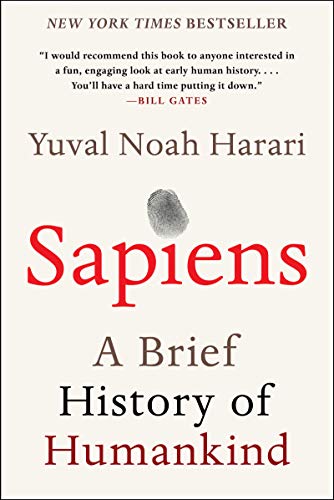
Few books of this century have colonized dinner-party conversation like Sapiens. Yuval Noah Harari, then an obscure Israeli historian of medieval warfare, set out to tell the entire story of our species in four hundred pages. The result sold more than twenty five million copies, earned endorsements from Bill Gates and Barack Obama and made "shared fictions" a phrase people now drop over coffee. A decade later it remains the book most likely to be someone's first step into big history.
What it's about
Harari organizes seventy thousand years around three revolutions. The Cognitive Revolution gave Homo sapiens its strange superpower: the ability to believe in things that do not physically exist, gods, nations, money, corporations, which lets millions of strangers cooperate. The Agricultural Revolution, in the book's most famous provocation, was "history's biggest fraud," trading foragers' varied lives for more calories, more people and more drudgery. The Scientific Revolution begins with an admission of ignorance and ends with humans acquiring powers previously reserved for gods, closing on the question of what we will do with them.
Along the way Harari argues money is the most universal system of mutual trust ever devised, empires did more unifying than we like to admit and happiness has improved far less than progress suggests. Every chapter has at least one idea you will want to argue about, which is the design.
Why everyone's talking about it
Sapiens became shorthand for a whole genre, in Silicon Valley it was practically issued equipment. Its frameworks echo through countless podcasts and keynotes. It also drew serious pushback. Anthropologists and historians catalog its oversimplifications; The Dawn of Everything was written partly as a rebuttal to its tidy arcs. The AI era gave Harari a second act as a doomsayer-in-chief, sending readers back to where his argument started.
The verdict, for now
Read it for what it is: a brilliant synthesis and conversation engine, not a textbook. Specialists are right that it flattens complexity and states guesses with the confidence of facts, so keep a grain of salt handy. But as a book that makes ordinary readers feel the strangeness of being human, then hungry to read five more books arguing with it, it has few equals. That is what a gateway is for.
Read it if you loved
Ready to read Sapiens?
Get it on Amazon →