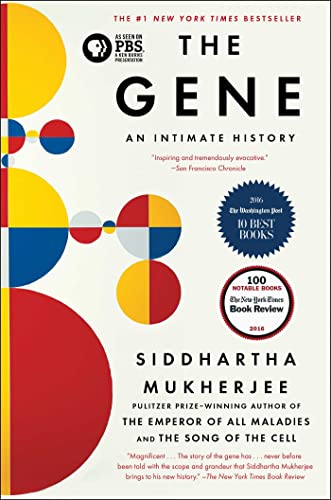
Siddhartha Mukherjee won a Pulitzer for writing cancer's biography. In The Gene he attempts something harder: the biography of the idea that makes us who we are. It opens not in a laboratory but on a train to a Calcutta asylum, where two of Mukherjee's uncles and a cousin were lost to mental illness that runs through his family like a dark thread. That question, what exactly gets passed down and what it means to know, powers six hundred pages of history that read like a family secret slowly coming into focus.
What it's about
The history runs from Mendel's pea plants in a monastery garden and Darwin's parallel revolution through the rediscovery of heredity, the double helix and the genomic age of sequencing, CRISPR and embryo editing. Mukherjee gives the triumphs their full drama, Franklin's photograph, the race for the code, the Human Genome Project's audacity, but he refuses to let the story stay triumphant. The middle of the book walks directly into eugenics: the American sterilization laws, the Nazi programs that cited them and the sobering fact that the science of heredity has repeatedly been used as a weapon within living memory.
The final act turns to the present, where the questions stop being historical. If we can read a genome, what should we tell a patient about a risk that is only a probability? If we can write one, who decides which variations are defects and which are just difference? Mukherjee keeps returning to his family, schizophrenia hovering in the pedigree, to make the stakes personal rather than abstract.
Why everyone's talking about it
A number one bestseller, a PBS documentary from Ken Burns and a permanent slot on science reading lists made The Gene the standard public account of heredity. The CRISPR decade kept it current: every gene-editing headline, every embryo-screening startup and every ancestry-test revelation sends readers back to it for the context those stories skip.
The verdict, for now
It is long, occasionally repetitive and the science after 2016 has moved, most notably in editing tools and polygenic screening, so pair it with newer reporting for the frontier. But no book better fuses the science, history and moral weight of heredity into a single narrative. Few science writers alive turn a metaphor like Mukherjee. Essential.
Read it if you loved
Ready to read The Gene?
Get it on Amazon →