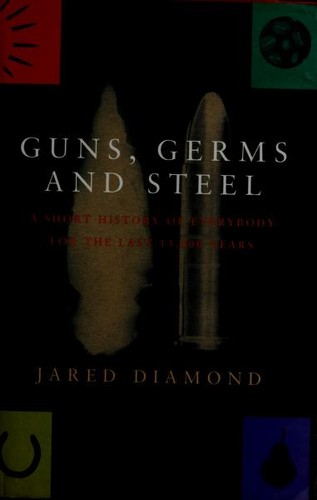
Why did Europeans end up colonizing much of the world, rather than the other way around? Guns, Germs and Steel is Jared Diamond's ambitious, Pulitzer-winning answer and whatever you make of it, it changed how a huge number of readers think about the deep patterns of history. It is the kind of big-picture book that gives you a whole new lens and a whole new set of things to argue about.
What it's about
Diamond's project is to explain the broad sweep of human history without resorting to racist or nationalist myths about some peoples being smarter or more industrious. His answer is geography and luck. Some regions, above all the Fertile Crescent, happened to have the right wild plants and large mammals to domesticate. That head start in agriculture allowed dense populations, food surpluses, specialized labor, writing, technology and, crucially, the epidemic diseases that come from living alongside animals.
Those advantages compounded over thousands of years into the guns, germs and steel of the title. When societies with them finally met societies without, the outcome was brutally lopsided and the germs often did more conquering than the guns. Diamond ranges across continents and millennia to argue that environment, not innate ability, set the starting conditions for everything that followed.
Why everyone's talking about it
Guns, Germs and Steel became a global bestseller and a staple of classrooms and book clubs, one of the most widely read works of popular history ever. Its geographic thesis reshaped mainstream understanding of world history, even as specialists have pushed back hard on where it oversimplifies.
If you want a sweeping, thought-provoking framework for how the modern world came to be so unequal, this is a landmark read. It should be taken as a bold argument rather than settled fact: many historians and anthropologists find it too deterministic and too tidy and those criticisms are worth reading alongside it. Come for the grand unifying theory and stay for the debate it will start in your own head.
The verdict, for now
Read it as a provocation, not a verdict. Come for a sweeping, geography-first explanation of human history, stay for the big questions and vigorous arguments it opens up. Few books this ambitious are this readable, or this productively contested.
Read it if you loved
Ready to read Guns, Germs, and Steel?
Get it on Amazon →