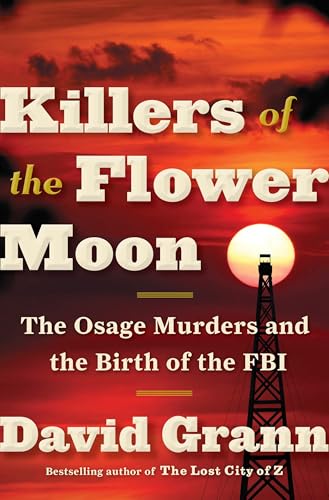
Some books excavate a crime. This one excavates a cover-up so vast it implicates an entire culture of looking away. David Grann's account of the Osage murders of the 1920s became an instant classic of narrative nonfiction when it appeared in 2017; nearly a decade later it remains the book people hand to friends who claim they don't read history.
What it's about
In the early twentieth century, the Osage Nation of Oklahoma became, per capita, among the wealthiest people on earth. Oil had been discovered beneath their land. Then, one by one, Osage people began to die: shot, poisoned, blown up in their own homes. The killings centered on the family of Mollie Burkhart, whose sisters and mother died in succession while white guardians, doctors, lawyers plus local lawmen either participated in the plunder or declined to see it.
Grann structures the book in three movements. The first follows Mollie and the mounting terror in Osage County. The second follows Tom White, the former Texas Ranger dispatched by a young J. Edgar Hoover, whose investigation helped establish the reputation of the fledgling FBI. The third follows Grann himself into the archives, where he discovers the killings ran far wider than the official case ever acknowledged.
Why everyone's talking about it
The book was a National Book Award finalist, won the Edgar Award for Best Fact Crime; it then reached an even larger audience through Martin Scorsese's 2023 film adaptation starring Leonardo DiCaprio and Lily Gladstone. Notably, the film's development echoed a critique of the book itself: early drafts centered the FBI investigator before Scorsese reoriented the story around Mollie and Ernest Burkhart. That conversation about whose story this is has kept the book urgently discussed in classrooms, book clubs and Osage communities alike.
The verdict, for now
This is nonfiction at its most gripping; Grann's research is meticulous, his prose restrained, his final section genuinely devastating in its implication that the "Reign of Terror" was less a conspiracy than a system. The honest caveat: the long middle stretch devoted to Tom White and the birth of the FBI can feel like a detour from the Osage themselves, giving the bureau a heroic arc that the book's own ending complicates. Some readers also find the third act's archival turn quieter than what precedes it. Minor reservations. If you read one work of American true crime, this is a defensible answer; it changes how you see oil money, guardianship law and the price of forgetting.
Read it if you loved
Ready to read Killers of the Flower Moon?
Get it on Amazon →