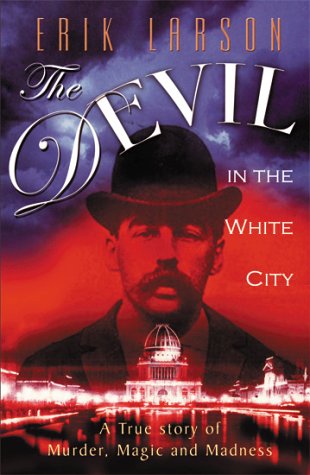
Two men arrive in Chicago in the early 1890s. One is Daniel Burnham, the architect charged with building the 1893 World's Fair out of swampland on an impossible deadline. The other is H. H. Holmes, a charming young doctor quietly constructing a hotel a few miles away with soundproofed rooms, gas lines to nowhere, a basement kiln. Erik Larson braids their stories into one of the most successful nonfiction books of the century.
What it's about
The White City half of the book follows Burnham as he wrangles egos, weather, labor unrest, financial panic; all of it in service of a fair meant to answer Paris and its Eiffel Tower. Larson makes the logistics genuinely gripping: the invention of the Ferris wheel, the landscaping of Frederick Law Olmsted, the sheer improbability that the thing opened at all. The fair drew millions of visitors; it reshaped American architecture, city planning, even the products on grocery shelves.
The dark half belongs to Holmes, the swindler now remembered as one of America's first documented serial killers. He used the fair's crowds as cover, luring young women arriving alone in a booming, anonymous city. Larson reconstructs his schemes, his marriages, his insurance frauds, then the slow unraveling as a dogged detective picks up the trail. The two narratives never truly meet; the fair is the stage, Holmes the shadow at its edge.
Why everyone's talking about it
Published in 2003, the book won the Edgar Award for fact crime, was a finalist for the National Book Award, then simply refused to leave bestseller lists; it has sat near the top of the historical true crime category for over two decades. A screen adaptation linked at various points to Leonardo DiCaprio and Martin Scorsese has kept it in entertainment headlines for years. More than any single title, it created the template for narrative nonfiction that reads like a thriller.
The verdict, for now
This is the rare history book that people press on friends who claim they only read fiction. The prose is cinematic; the research, drawn from period sources, is worn lightly. The honest caveat: the Holmes chapters lean on novelistic reconstruction, imagining moods, glances, interior thoughts no record could verify, which has drawn fair criticism from historians. Later research also suggests Holmes's mythology outgrew his documented crimes. Some readers find the Burnham sections slower than the murders; others feel the opposite. Read it as masterful storytelling built on history rather than history itself. On those terms it fully deserves its reputation.
Read it if you loved
Ready to read The Devil in the White City?
Get it on Amazon →