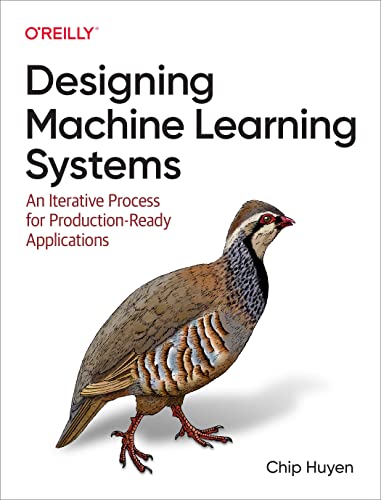
There is a canyon between training a model that works in a notebook and running one that works in production. Most machine learning education stops at the edge of it. Chip Huyen's Designing Machine Learning Systems is the book that walks you across. Drawing on her years building ML infrastructure at Netflix, NVIDIA and her own startup, Huyen wrote the missing manual for the unglamorous ninety percent of the job: data, deployment, monitoring and everything that breaks after launch.
What it's about
The book follows an ML system through its whole life. It starts before any model exists, with framing: whether a problem needs ML at all, how to translate a business goal into an objective a model can optimize and how those choices quietly decide a project's fate. Then comes the data engineering that dominates real workloads, training data creation, feature engineering, labels, sampling and the subtle ways skew creeps in between training and serving.
The back half is where it earns its reputation. Deployment strategies, batch versus streaming inference, model compression for latency budgets, then the chapters practitioners dog-ear: monitoring and drift. Models degrade silently as the world shifts under them. Huyen treats detection and continual learning as first-class design problems rather than afterthoughts. A closing stretch on infrastructure and team structure explains why MLOps is as much an organizational discipline as a technical one.
Why everyone's talking about it
Published in 2022, it became the standard MLOps text almost immediately: assigned in Stanford's ML systems course, cited in job postings and installed on the desk of nearly every ML platform team. The generative AI wave that followed made it more relevant, not less, since serving, evaluating and monitoring models at scale is precisely what the industry suddenly needed to do. Huyen's follow-up on AI engineering became a phenomenon partly because this book had already made her the trusted voice on production ML.
The verdict, for now
The tradeoff is inherent to the subject: tools change fast, so Huyen teaches principles and mostly avoids specific frameworks, which occasionally leaves you wanting one worked example with real code. Readers new to ML should learn the modeling basics elsewhere first. But if your models have users, this is the field guide to keeping them alive. It has aged better than almost anything else in the category.
Read it if you loved
Ready to read Designing Machine Learning Systems?
Get it on Amazon →