Most startup books tell you how to compete. Zero to One argues you should not compete at all. Built from a Stanford course taught by PayPal and Palantir co-founder Peter Thiel, it is short, contrarian and dense with quotable ideas and it has become one of the most widely read business books of the past decade precisely because it refuses to say the expected thing.
What it's about
The title captures the thesis. Going from one to n means copying something that already works, opening another restaurant, launching another me-too app. Going from zero to one means creating something that never existed before. Thiel is interested only in the latter and he argues that genuine progress comes from these vertical leaps, not from incremental competition.
From there he makes a series of deliberately provocative claims. Competition is for losers; the goal should be a monopoly built on doing something so uniquely well that no one else can touch it. Great companies are built on a secret, an important truth that almost no one agrees with. Founders should think for themselves rather than follow the crowd, plan boldly rather than trusting luck and understand that a tiny number of bets produce almost all the returns. It is part strategy, part philosophy, part manifesto.
Why everyone's talking about it
Zero to One became a modern startup classic, quoted constantly in Silicon Valley and beyond and it made Thiel's contrarian framework, monopoly over competition, secrets, definite optimism, part of the standard vocabulary of founders and investors.
If you are building or thinking about building something new, this is a genuinely stimulating read that will sharpen how you think, even where you disagree. Readers should approach it critically: Thiel's politics and some of his generalizations are divisive and "seek a monopoly" is advice that cuts more than one way. Come for the zero-to-one framing and stay for a bracing challenge to lazy, imitative thinking.
The verdict, for now
Read it with a pen and an argument ready. Come for the contrarian case against competition, stay for a set of provocations that force you to think harder about what is actually worth building. Agree or not, it does not let you coast.
Read it if you loved
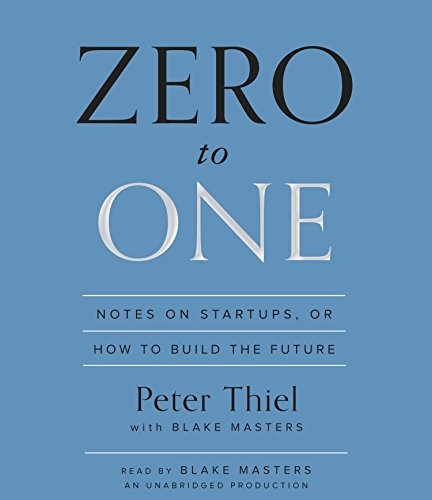
Ready to read Zero to One?
Get it on Amazon →