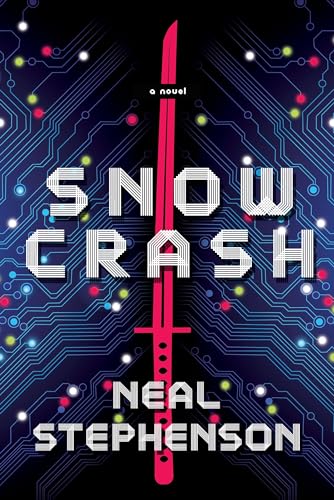
Few novels get name-checked in Silicon Valley as often as Snow Crash. Neal Stephenson's 1992 cyberpunk landmark coined the word Metaverse decades before Facebook rebranded itself around the concept. It is also a gonzo satire of franchised America that opens with a katana-carrying pizza deliveryman racing a deadline for the Mafia. The book's reputation as tech prophecy tends to obscure how deliberately absurd it is.
What it's about
Hiro Protagonist delivers pizza in a near-future America where the federal government has withered into irrelevance. The country has splintered into corporate franchise nations, gated burbclaves and privatized highways. Hiro is also a gifted hacker who helped build the Metaverse, a shared virtual reality where millions of users walk a digital Street as avatars. When a new drug called Snow Crash begins frying the minds of hackers, crashing their avatars online while inflicting real neurological damage offline, Hiro starts tracing it to its source.
The trail runs through Y.T., a teenage skateboard courier who steals every scene she appears in, a fiber-optic media mogul named L. Bob Rife and a terrifying Aleut harpooner called Raven. It also runs backward through ancient Sumer. Stephenson spins an elaborate theory that language can operate like a virus on the human brain, with Sumerian myth as the original source code. Much of this arrives through long conversations between Hiro and a virtual librarian, a structure readers tend to find either fascinating or exhausting.
Why everyone's talking about it
Snow Crash never really left the conversation. When Facebook renamed itself Meta in 2021, journalists went straight back to Stephenson's novel, since the Metaverse the company was chasing came from these pages. Tech founders have cited it for decades; early virtual-world builders treated it as a design document, something Stephenson has regarded with visible ambivalence given that the book is a satire of corporate dystopia rather than a product roadmap. Its ideas about avatars, virtual real estate and digital status resurface every time a new immersive platform launches.
The verdict, for now
Snow Crash remains a blast, though not a flawless one. The opening chapters move with a velocity few science fiction novels have matched; the middle section slows badly under the weight of the Sumerian linguistics lectures, which read more like an annotated research binder than a thriller. The ending is famously abrupt, a recurring Stephenson complaint that started here. Characterization runs thin outside Hiro and Y.T. None of that sinks it. As satire, as world-building, as accidental prophecy, this is essential reading for anyone curious where the internet's dreams about itself came from.
Read it if you loved
Ready to read Snow Crash?
Get it on Amazon →