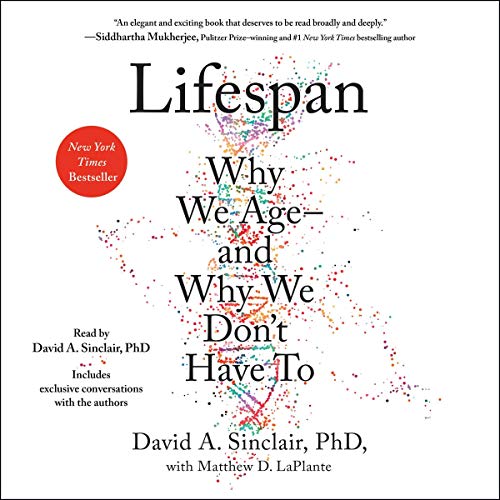
Few science books have the nerve to open with a thesis this audacious: aging is not an inevitable fact of life but a disease. A treatable one. David Sinclair, a Harvard Medical School geneticist who has spent decades studying why our bodies break down, argues in Lifespan that the first person to live to 150 may already be alive. Whether you find that thrilling or eyebrow-raising says a lot about how you'll take the rest of the book.
What it's about
Sinclair's central idea is what he calls the information theory of aging. In his telling, we age not because our DNA accumulates damage but because our cells gradually lose epigenetic information, the instructions that tell each cell what kind of cell to be. Like a scratched DVD, the underlying data is still there; the machine just struggles to read it. If aging is an information problem, he argues, it can in principle be repaired.
From that foundation the book tours the science of longevity: sirtuins, the protective enzymes Sinclair's lab helped make famous; NAD+, the molecule those enzymes depend on, which declines as we age; plus practical levers like intermittent fasting, exercise, cold exposure and cutting back on meat. Written with journalist Matthew D. LaPlante, it closes with sweeping chapters on what radically longer lives would mean for medicine, retirement, the planet and human purpose.
Why everyone's talking about it
Lifespan became a New York Times bestseller when it landed in 2019 and turned Sinclair into one of the most visible faces of the longevity movement, alongside podcast circuits, biotech ventures and a wave of imitators. It arrived just as longevity went mainstream; billionaires were funding anti-aging startups, NAD+ boosters were hitting shelves and "healthspan" was entering everyday vocabulary. Sinclair's own openness about taking molecules like NMN, resveratrol and metformin made the book feel like a peek at a protocol, which is exactly why it spread.
The verdict, for now
This is a genuinely exciting tour of aging biology from someone at the center of the field, written with contagious optimism and real narrative skill. It is also a book to read critically. Sinclair has financial stakes in longevity companies, several fellow scientists have called his claims ahead of the evidence and the resveratrol story he helped launch has notably deflated since the early hype. None of the interventions he describes are proven to extend human lifespan. Read it for the big ideas and the spark; check with the broader scientific consensus before rebuilding your medicine cabinet around it.
Read it if you loved
Ready to read Lifespan?
Get it on Amazon →