Some books earn their reputation through marketing muscle. Into Thin Air earned its place the hard way: Jon Krakauer was on Everest in May 1996 when a storm killed eight climbers in a single night, including two of the most experienced guides on the mountain. Nearly three decades later, this remains the book people reach for when they want to understand why humans keep walking into the death zone.
What it's about
Krakauer went to Everest on assignment for Outside magazine, joining Rob Hall's commercial expedition to report on the growing business of guided climbs. He summited on May 10, 1996. Within hours, a blizzard trapped dozens of climbers high on the mountain. Hall, fellow guide Scott Fischer, several clients never came down. Krakauer descended safely; the guilt of that survival powers every page.
The book expands his original magazine piece into a full reconstruction of the disaster: the crowded routes, the bottleneck at the Hillary Step, the turnaround times that guides set then ignored, the thin margins that separate a summit photo from a body left on the ridge. Along the way Krakauer examines the commercialization of Everest itself, where clients paying $65,000 expected to be delivered to the summit regardless of experience.
Why everyone's talking about it
Into Thin Air was a massive bestseller on release in 1997; it has never really left the conversation. Every new Everest season brings fresh photos of summit queues, which sends readers straight back to the book that predicted the problem. The 2015 film Everest dramatized the same events for a new audience. It also remains a fixture of journalism courses; the tension between Krakauer as reporter and Krakauer as participant is a case study in itself.
The verdict, for now
This is narrative nonfiction operating at full power: precise, self-lacerating, impossible to put down. But the book carries a genuine asterisk. Krakauer's harsh portrayal of guide Anatoli Boukreev, who descended ahead of his clients but then made repeated solo rescue trips into the storm, sparked a bitter public dispute; Boukreev's own account, The Climb, tells a very different story. Krakauer himself concedes that memory formed at 29,000 feet without supplemental oxygen is unreliable, which means parts of this reconstruction rest on shakier ground than its confident prose suggests. Read it as one survivor's honest attempt to make sense of catastrophe rather than a settled verdict. On those terms it is essential.
Read it if you loved
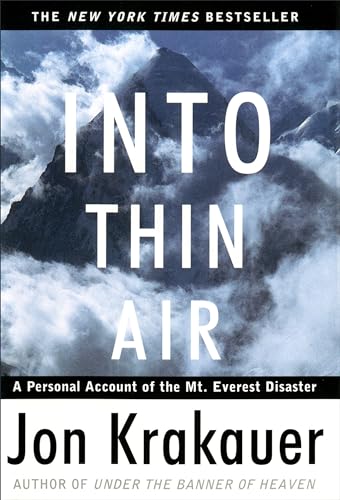
Ready to read Into Thin Air?
Get it on Amazon →