Few books have done more to reshape how we understand human judgment than Thinking, Fast and Slow. Daniel Kahneman, a psychologist who won the Nobel Prize in economics, spent his career proving that people are far less rational than we like to believe and here he gathers it all into one grand, career-capping synthesis. It is dense and it is worth every page.
What it's about
Kahneman's organizing metaphor is two systems. System 1 is fast, automatic and intuitive: it jumps to conclusions, reads emotions and reacts before you know you are reacting. System 2 is slow, effortful and deliberate: it does the hard arithmetic and the careful reasoning, but it is lazy and easily tired, so it often just rubber-stamps whatever System 1 hands it. Most of the errors in human judgment, Kahneman argues, come from trusting fast intuition when the situation demands slow thought.
From that framework he unpacks a parade of biases that shape everyday life: anchoring, loss aversion, the halo effect, overconfidence, our terrible instincts about probability. Each is illustrated with the clever experiments that made his reputation and the cumulative effect is humbling. You finish the book newly suspicious of your own certainty, which is precisely the point.
Why everyone's talking about it
Thinking, Fast and Slow became one of the defining nonfiction books of the century, foundational to behavioral economics and endlessly cited in business, medicine, policy and design. Its vocabulary, System 1 and System 2, anchoring, priming, has become part of how educated people talk about the mind.
If you want to understand why smart people make predictable mistakes and to catch yourself doing it, this is the essential text. Be warned that it is a serious, sometimes technical read that rewards patience rather than skimming and a few of its cited studies have been questioned in the years since. Come for the two-systems idea and stay for a career's worth of insight into the machinery of thought.
The verdict, for now
Read it slowly, appropriately enough. Come for the fast-and-slow framework, stay for a masterclass in the biases that quietly run your decisions. It asks real effort and repays it with a permanently sharper view of your own mind.
Read it if you loved
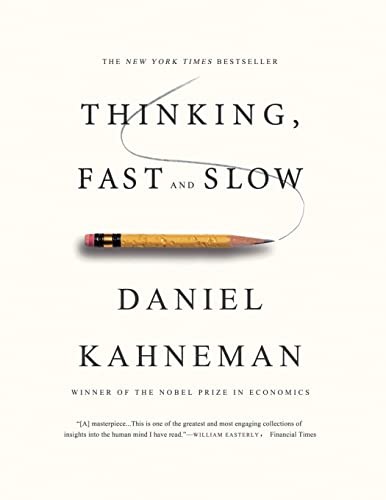
Ready to read Thinking, Fast and Slow?
Get it on Amazon →