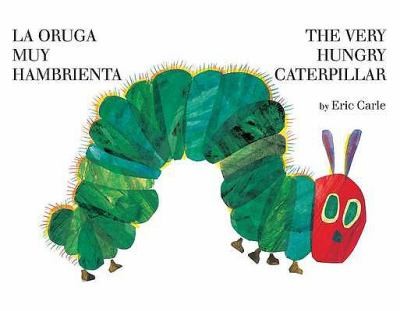
Few children's books earn the word iconic; this one collaged its way there. Eric Carle's The Very Hungry Caterpillar has been a first book for generations since 1969, translated into more than 60 languages with sales in the tens of millions. The text runs barely 224 words. The question worth asking is why something this small keeps outselling nearly everything else on the picture-book shelf.
What it's about
A tiny caterpillar pops out of an egg on Sunday morning, ravenous. Over the week he eats through an escalating menu: one apple on Monday, two pears on Tuesday, three plums on Wednesday, building toward a Saturday blowout of cake, ice cream, salami, a pickle plus half a dozen other indulgences. Carle's famous die-cut holes are punched straight through the pages, so small fingers can trace exactly where the caterpillar has chewed. The book's physical design is the plot.
The feast ends predictably, with a stomachache. One nice green leaf on Sunday settles everything. Now big and fat, the caterpillar builds a cocoon around himself, waits two weeks, then emerges as a spectacular butterfly in a full-spread finale. Along the way children quietly absorb counting, days of the week, food names, a loose outline of metamorphosis. Carle's tissue-paper collage art, all saturated color and rough hand-cut edges, carries most of the storytelling; the words mostly stay out of its way.
Why everyone's talking about it
Because it never left. The book has been in continuous print since 1969, spawning board books, plush caterpillars, animated adaptations, anniversary editions, even a museum: The Eric Carle Museum of Picture Book Art in Massachusetts grew out of its creator's stature. Educators keep it in rotation because it teaches three curricula at once without ever feeling like a lesson. Carle's death in 2021 brought a fresh wave of tributes, introducing the caterpillar to yet another generation of new parents.
The verdict, for now
Buy it for any child under five; that part is easy. The honest caveats: scientists have long pointed out that butterflies emerge from a chrysalis, not a cocoon, a word Carle defended as poetic license rather than biology. More practically, this is a concept book rather than a story, so the adult reading it for the ninetieth consecutive night will find little narrative to hold onto. That trade is worth making. As a machine for teaching numbers, days, appetite, transformation, it remains the standard everything else on the board-book shelf gets measured against.
Read it if you loved
Ready to read The Very Hungry Caterpillar?
Get it on Amazon →