
The best portable power stations do two things well: keep your devices running at a campsite and provide reliable backup when the grid goes down at home. We compared seven models across capacity, output wattage, charging speed, portability, and real-world owner feedback (over 27,000 combined reviews) to find the ones worth your money.
Whether you need a compact unit for weekend car camping or a high-capacity station that can run a mini fridge during a power outage, this guide breaks down exactly what to buy, and what to skip.
How We Picked These Portable Power Stations
We focused on five criteria that matter most for camping and home backup use:
- Capacity (Wh). Watt-hours determine how long a station can power your gear. A 500Wh unit can charge a phone roughly 40 times or run a CPAP machine for 8 to 10 hours. We prioritized stations with at least 150Wh for camping and 500Wh or more for home backup.
- Output ports. The best stations offer a mix of AC outlets, USB-A, USB-C, and 12V DC ports. More port variety means fewer adapters to carry.
- Weight and portability. A 50-pound station is fine for your garage but miserable at a campsite. We weighed portability against capacity for each recommendation.
- Charging options. Wall charging, car charging, and solar compatibility all matter. Stations that support solar input score higher because they can recharge off-grid indefinitely.
- Owner satisfaction. We analyzed thousands of verified reviews, filtering for patterns in long-term reliability, customer service experiences, and real-world performance versus manufacturer claims.
1. Jackery Explorer 500: Best Overall Portable Power Station
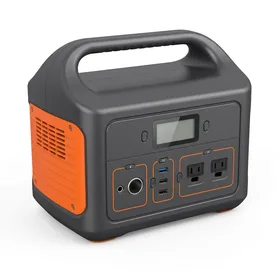
Jackery Portable Power Station Explorer 500
Best for: Best overall for camping and light home backup
The Explorer 500 hits the sweet spot between capacity and portability. It is the best portable power station for most campers and a solid entry point for light home backup.
The Jackery Explorer 500 is the portable power station we recommend to most people. With 518Wh of lithium battery capacity, it provides enough juice to charge laptops, run a portable fan, power LED lights, and keep phones topped off for an entire weekend camping trip without a recharge.
For home backup, the Explorer 500 handles the essentials during short outages: charging phones and tablets, running a Wi-Fi router, and powering small medical devices like CPAP machines. Its pure sine wave inverter means you do not have to worry about damaging sensitive electronics.
The 4.8-star rating across 6,451 reviews is not inflated. Owners consistently praise its build quality and reliability over multi-year ownership. The most common criticism is the wall charging speed (roughly 7.5 hours for a full charge), which is worth planning around if you use it frequently.
Who should buy this: Campers who want a reliable, mid-capacity station that covers phones, laptops, lights, and small appliances. Also a smart pick for apartment dwellers who want basic outage protection without spending over $1,000.
Who should skip this: Anyone who needs to run high-draw appliances (space heaters, full-size fridges, power tools) or who needs faster recharge times for daily use.
2. Jackery Solar Generator 1000: Best for Home Backup
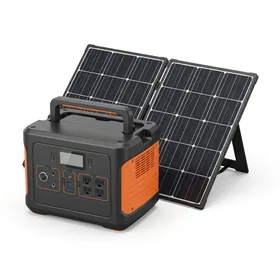
Jackery Solar Generator 1000 (Explorer 1000 + 2x SolarSaga 100W)
Best for: Best portable power station for home backup and extended off-grid trips
If you want a portable power station that can genuinely serve as home backup during outages, the Explorer 1000 bundle delivers. The included solar panels make it a self-sustaining system.
The Jackery Solar Generator 1000 is the best portable power station for home backup in this roundup. The 1002Wh capacity and 1000W continuous output (2000W surge) mean it can run appliances that smaller stations simply cannot handle: mini fridges, blenders, small power tools, and multiple devices simultaneously.
What makes this bundle particularly compelling is the inclusion of two SolarSaga 100W panels. Together, they can fully recharge the Explorer 1000 in roughly 8 hours of direct sunlight. That turns this from a one-use battery into a renewable power system, which is exactly what you want during an extended outage or a week-long camping trip.
At $749, this is not an impulse purchase. But when you compare it to a traditional gas generator (which requires fuel, produces fumes, makes noise, and cannot be used indoors), the value proposition becomes clearer. This is silent, emission-free, and safe to use inside your home.
Who should buy this: Homeowners in areas prone to power outages, RV owners, and extended-trip campers who need high capacity and solar recharging capability.
Who should skip this: Weekend campers who only need to charge phones and run lights. The Explorer 500 saves you $430 and the FlashFish 200W saves you $649.
3. FlashFish 200W Portable Power Station: Best Under $150
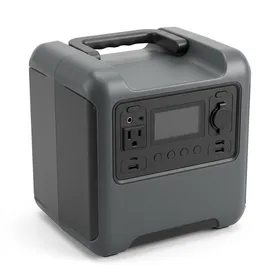
FlashFish 200W Portable Power Station
Best for: Best portable power station under $150 for casual camping
A solid budget pick for campers who need basic power on the go. Do not expect it to run anything larger than a laptop, but for phones, lights, and small fans, it does the job at a great price.
Not everyone needs 500Wh or more of capacity. If your camping setup involves charging phones, running a portable fan, and powering a Bluetooth speaker, the FlashFish 200W gets the job done at $99.99.
The 40800mAh (151Wh) battery provides enough power for roughly 12 phone charges or 5 to 6 hours of running small devices. It includes a 110V AC outlet (pure sine wave), two USB-A ports, and a DC output, which covers the basics without overcomplicating things.
The 4.4-star rating across 4,219 reviews reflects a tradeoff: you get excellent value for the price, but the build quality and longevity do not match Jackery or EcoFlow products that cost 3 to 5 times more. Several reviewers noted that the battery capacity degrades faster after 200 or more charge cycles compared to premium lithium-ion cells.
That said, as a best portable power station under $150, it is hard to beat. Think of it as an entry-level option that lets you test whether a portable power station fits your lifestyle before committing to a larger investment.
4. Jackery Explorer 160: Best Ultraportable Power Station
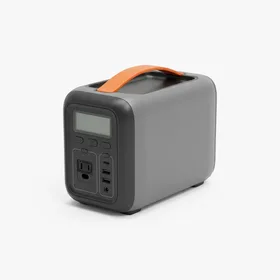
Jackery Portable Power Station Explorer 160
Best for: Best ultraportable power station for minimalist campers and day trips
The Explorer 160 is the power station you throw in a daypack without thinking twice. It will not run a mini fridge, but for phones, tablets, and small lights, the portability is unmatched.
At 3.84 pounds, the Jackery Explorer 160 is the most portable power station in this roundup by a wide margin. It fits in a large jacket pocket or the side pouch of a backpack, which makes it genuinely useful for day hikes, motorcycle trips, or flights where every ounce matters.
The 167Wh capacity translates to roughly 13 phone charges, 2 to 3 tablet charges, or 6 hours of running a small LED lantern. That is plenty for a weekend if your power needs are modest.
What you get with the Explorer 160 that you do not get with a cheap power bank is the AC outlet. Even though it is limited to 100W, having a standard wall plug on a portable device opens up options: small drone chargers, camera battery chargers, and travel electronics that only come with AC adapters.
The 4.7-star rating across 5,344 reviews is strong, and owners consistently highlight the reliability. Many reviewers report using the Explorer 160 for 3 or more years without noticeable battery degradation.
5. Jackery SolarSaga 60W Solar Panel: Best Solar Charging Add-On
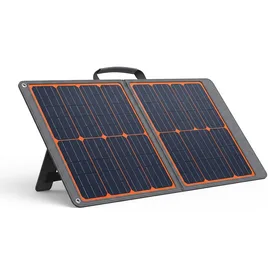
Jackery SolarSaga 60W Solar Panel
Best for: Best solar panel accessory for Jackery Explorer 160, 240, and 500
If you already own a Jackery Explorer 160 or 500, the SolarSaga 60W panel turns your power station into a self-sustaining system. Essential for trips longer than two days.
A portable power station is only as useful as its ability to recharge. If you are camping for more than a weekend or preparing for multi-day power outages, a solar panel transforms a one-time battery into a renewable power source.
The Jackery SolarSaga 60W panel is specifically designed for the Explorer 160, 240, and 500. It folds flat for transport and includes an integrated kickstand for optimal sun positioning. Under ideal conditions, it delivers roughly 60W of charging power, which means a full recharge of the Explorer 160 in approximately 3.5 hours and the Explorer 500 in about 9.5 hours.
The panel also includes built-in USB-A and USB-C ports, so you can charge phones and tablets directly from sunlight without routing through a power station. That is a useful feature for conserving your station's stored energy for higher-draw devices.
Reviewers note that real-world output typically lands between 40W and 55W depending on cloud cover, sun angle, and temperature. That is normal for portable solar panels and worth factoring into your recharge time expectations.
6. GLCON Hard Protective Travel Case: Best Accessory for Power Station Owners
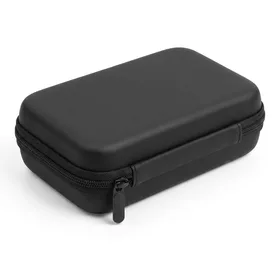
GLCON Hard Protective Travel Case for Portable Chargers
Best for: Best protective case for small power stations and charging accessories
At $9.88, this is the cheapest way to protect your portable charger investment. Toss it in your pack and stop worrying about scratches and drops.
This is not a power station, but it solves a real problem that power station owners face: protecting your investment during transport. The GLCON hard case fits smaller portable chargers and compact power stations like the Jackery Explorer 160. Its hard shell absorbs impact, and the interior mesh pocket keeps cables organized instead of tangled at the bottom of your bag.
At $9.88 with 4,324 reviews and a 4.6-star rating, it is one of those accessories you buy once and appreciate every trip.
How All 6 Products Compare
Which Portable Power Station Should You Buy?
The right station depends entirely on your use case and budget. Here is a quick decision framework:
Spend $99 if you are a casual camper who needs to charge phones and run small devices. The FlashFish 200W covers the basics without breaking the bank. Think of it as a test run before investing in something bigger.
Spend $139 if portability matters more than capacity. The Jackery Explorer 160 weighs under 4 pounds and fits in a backpack. Perfect for day trips, motorcycle camping, and minimalist setups.
Spend $319 if you want the best balance of capacity, portability, and reliability. The Jackery Explorer 500 is the one we recommend to most people. It handles weekend camping trips, short power outages, and daily laptop charging without breaking a sweat.
Spend $749 if you need genuine home backup capability or extended off-grid power. The Jackery Solar Generator 1000 bundle is the best portable power station for home backup in this roundup, and the included solar panels make it a self-sustaining system.
For most campers and home backup shoppers, the Jackery Explorer 500 at $319 delivers the best combination of capacity, portability, and long-term reliability across 6,451 verified reviews.
How Long Does a Portable Power Station Last?
Battery lifespan depends on chemistry and usage. Most lithium-ion portable power stations retain 80% of their original capacity after 500 charge cycles. For a weekend camper who charges the station once a week, that translates to roughly 10 years of useful life.
During a single charge, runtime depends on what you are powering. A 500Wh station running a 50W device (like a laptop) lasts about 10 hours. Running a 100W device (like a small TV) cuts that to about 5 hours. The math is straightforward: divide the station's capacity (Wh) by the device's power draw (W) to estimate runtime in hours. Factor in roughly 15% efficiency loss from the inverter.
For home backup scenarios, a 1000Wh station can power a Wi-Fi router (10W), charge two phones (10W each), and run LED lights (15W) for over 20 hours. That is enough to get through most outages comfortably.
Jackery vs Bluetti vs EcoFlow: Quick Take
These three brands dominate the portable power station market. Based on our analysis of portable power station reviews across all three:
Jackery leads in reliability and customer satisfaction. Their products consistently earn 4.7 or higher ratings, and long-term reviewers report fewer issues after years of use. The tradeoff is slower charging speeds compared to newer competitors.
Bluetti offers competitive pricing and higher capacities at similar price points. Their LiFePO4 battery chemistry in newer models provides longer cycle life (2,500+ cycles versus 500 for standard lithium-ion). Worth considering if you prioritize long-term value.
EcoFlow wins on charging speed. The EcoFlow Delta 2 can recharge from 0 to 80% in under an hour via wall outlet, which is dramatically faster than any Jackery model. If fast recharging matters to your workflow, EcoFlow deserves a look.
For this roundup, Jackery dominates our product list because their Explorer series has the deepest pool of long-term reviews and the highest owner satisfaction scores. But the portable power station market evolves quickly, and all three brands make excellent products.